Abstract
We present a novel combustion simulation framework to model fire phenomena across solids, liquids, and gases. Our approach extends traditional fluid solvers by incorporating multi-species thermodynamics and reactive transport for fuel, oxygen, nitrogen, carbon dioxide, water vapor, and residuals. Combustion reactions are governed by stoichiometry-dependent heat release, allowing an accurate simulation of premixed and diffusive flames with varying intensity and composition. We support a wide range of scenarios including jet fires, water suppression (sprays and sprinklers), fuel evaporation, and starvation conditions. Our framework enables interactive heat sources, fire detectors, and realistic rendering of flames (e.g., laminar-to-turbulent transitions and blue-to-orange color shifts). Our key contributions include the tight coupling of species dynamics with thermodynamic feedback, evaporation modeling, and a hybrid SPH-grid representation for the efficient simulation of extinguishing fires. We validate our method through numerous experiments that demonstrate its versatility in both indoor and outdoor fire scenarios.
Video
Overview
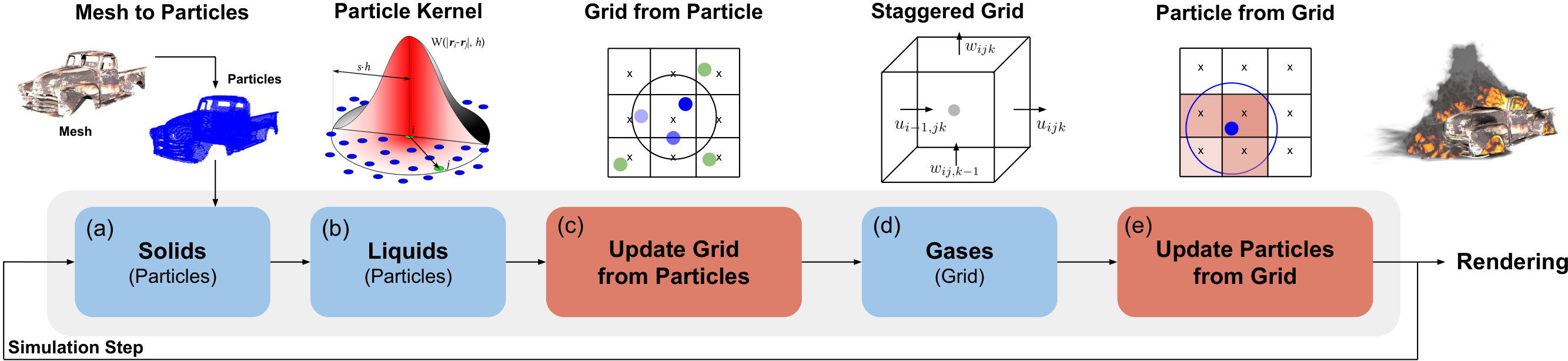
Overview of our multiphase framework: our liquid-gas-solid model enables simulating the thermodynamics of solids, liquids and gases. We use a Lagrangian representation for solids (a) and liquids (b) and an Eulerian representation for gases (d). To maintain all states of matter, we synchronize solid and fluid particles with the gas grid in two update steps (c, e).
Results
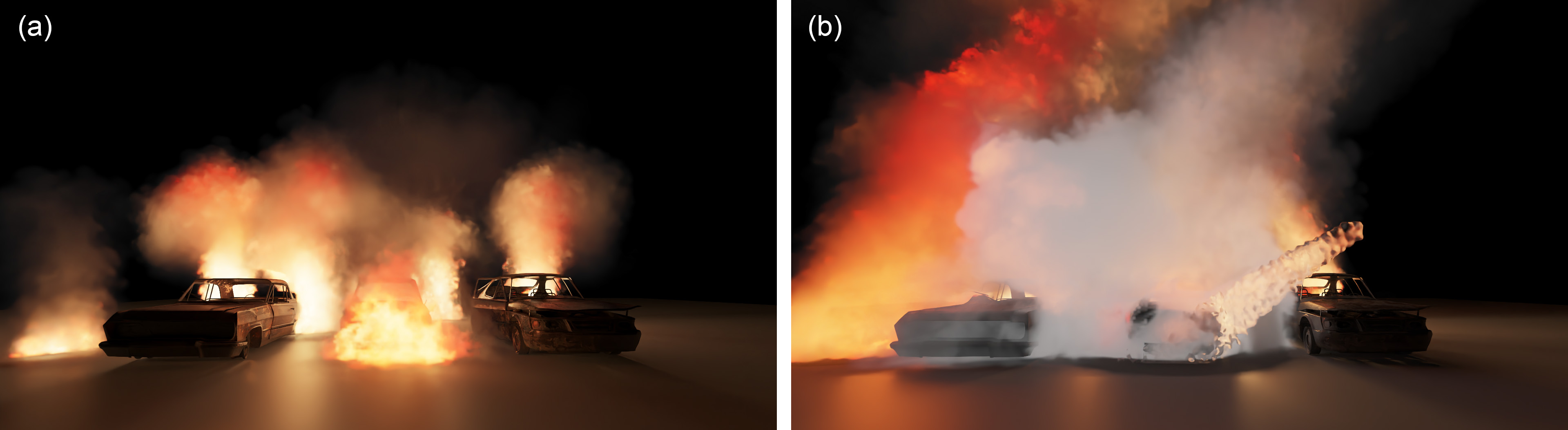
Two frames of a timeseries showing the extinction of a complex fire. Three vehicles are vigorously burning (a). The fire is then suppressed by a high-pressure water jet (b), producing dense clouds of smoke and vapor. Our advanced combustion model supports multi-species thermodynamics and accurately simulates flame extinction dynamics.
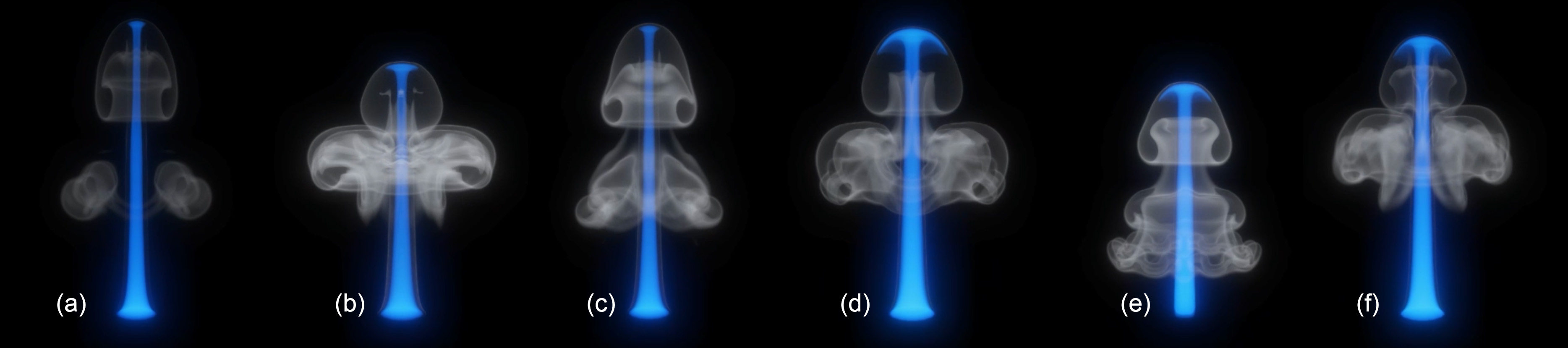
Visualization of various hydrocarbons: we simulate the the establishment of a flame 800 ms after ignition for Acetylene (a), Butane (b), Cyclopropane (c), Propane (d), Methane (e), and Ethylene (f). Our framework enables simulating stoichiometric mixtures of various fuels. The combustion patterns reflect differences in turbulence, stability, and height, related to molecule properties.
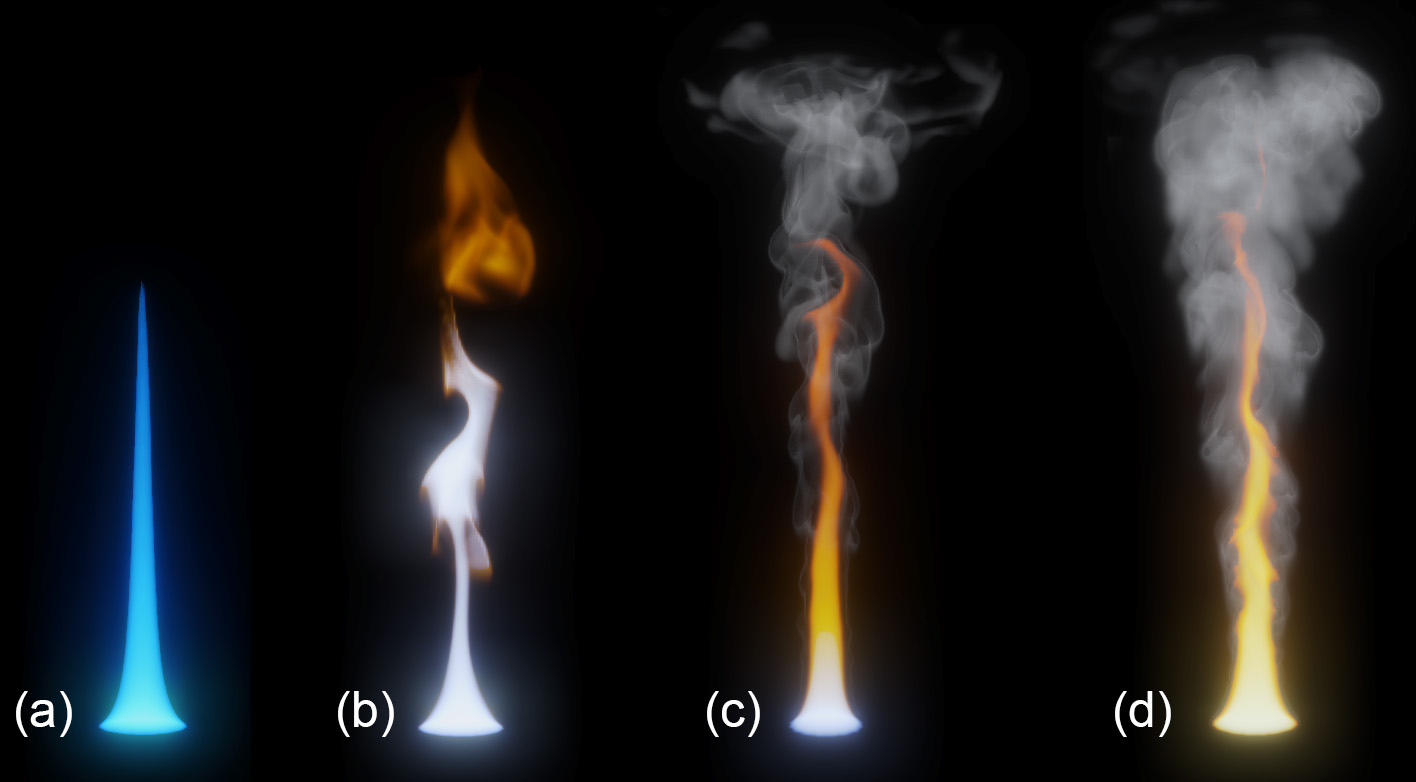
Four different species of small flame combustion: a clean combustion, common for a Bunsen burner and premixed combustion (a), a flame with a few traces of residuals that show visible glowing (b), an intermediate flame species where the bottom burns near complete combustion but water vapor and glowing residuals are already present in the upper parts of the flame (c), and an even more turbulent flame which shows large amounts water vapor and residuals, leading to colors typical for diffuse combustion (d).
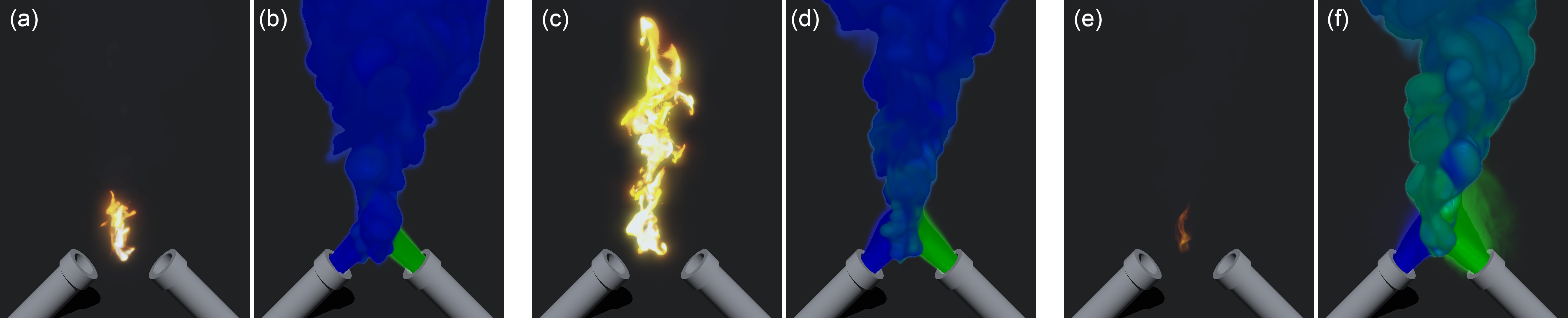
A series showing the combustion of methane and oxygen in a nitrogen environment. Oxygen is visualized in blue and fuel in green. The injected rate of oxygen is the same for the whole experiment, while the amount of fuel is ramped up from a mass fraction of 0.1 to 1.0 mixed with nitrogen. Additionally, a heat source is set up below the two emitters. (a, b) show the combustion with a fuel lean mixture, (c, d) show the stoichiometric mixture of fuel and oxygen and (e, f) show a fuel rich mixture caused by an injection of pure fuel mixing with pure oxygen.

Liquid fuel: As we simulate the thermodynamics between gases and liquids our framework enables simulating liquid fuel. A liquid fuel (ethanol) is emitted into a flame (a) and ignites (b). The burning liquid collides with obstacles in the scene (c) and continues to burn until all fuel is evaporated (d).
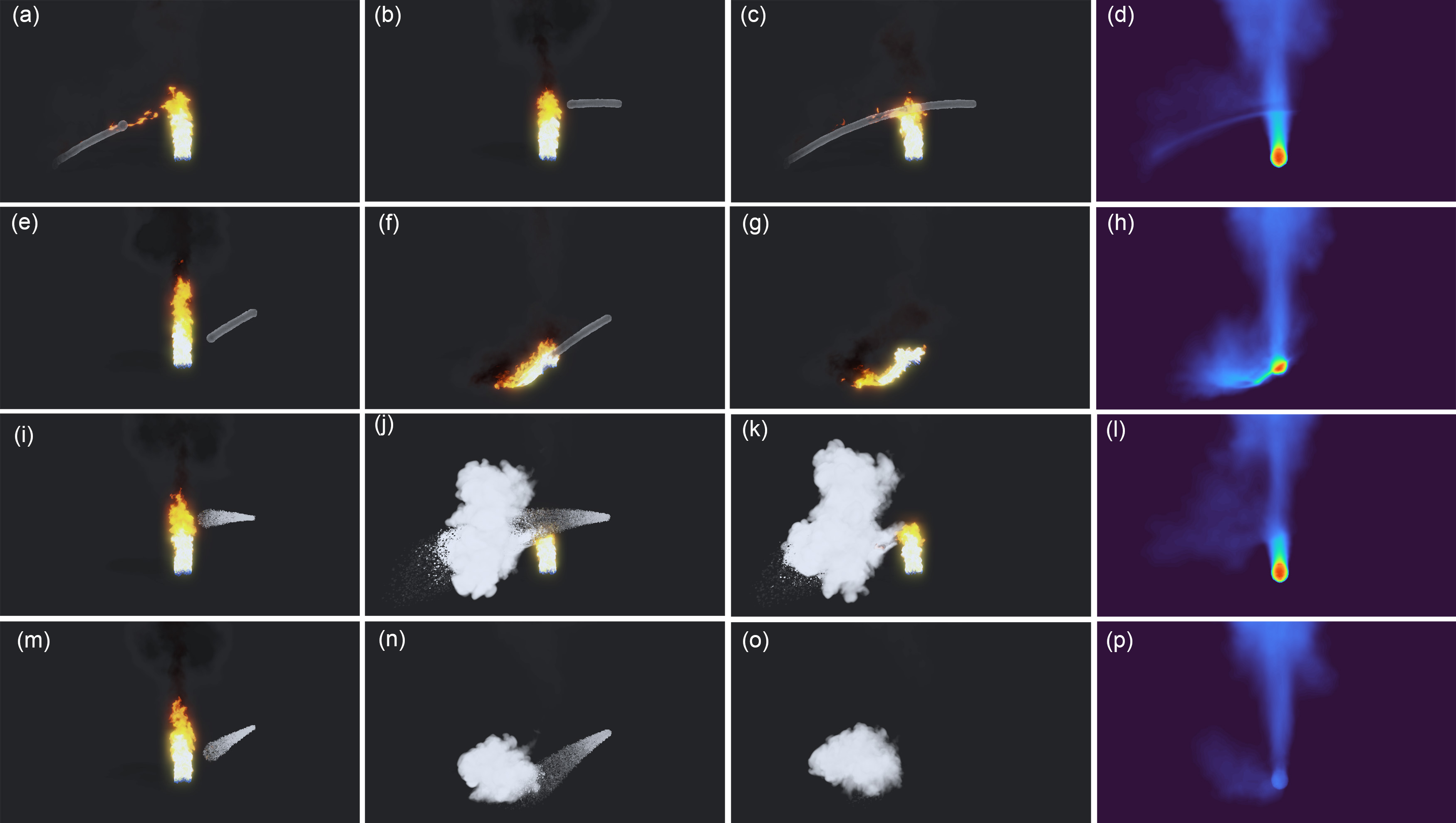
Water extinguishing experiments: we use two nozzle types to generate a laminar (a)-(h) and a spray (i-p) type of water stream to extinguish a flame and show the impact of aiming the water at the top of the flame (a-d, i-l) and at the bottom of the flame (e-h, m-p). For each fire-water interaction we show the average spatio-temporal temperatures (d, h, l, p) which show the overall effectiveness of extinquishing a flame during an experiment. A laminar water stream directed at the top of a flame does not impact the fire which leads to an overall high temperature. A spray stream directed at the bottom of the fire immediately stops the fire resulting in an overall lower temperature (p).
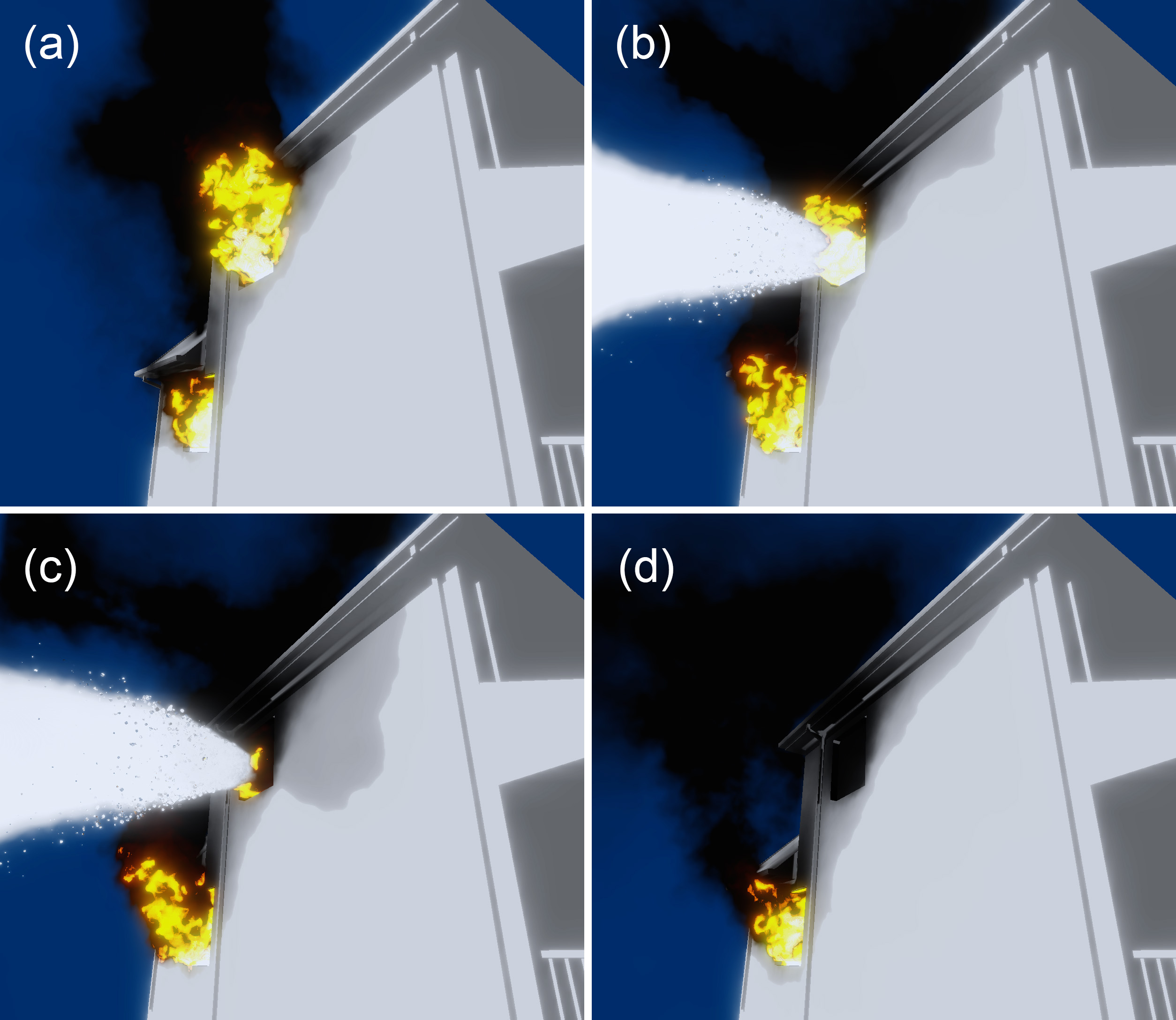
Simulation showing fire suppression at a window using principles of fluid dynamics. Flames and hot gases vent from the window (a). A water stream is directed outward from the window (b), creating a high-velocity flow that induces a low-pressure zone outside (Bernoulli Principle). This draws heat, smoke, and flames out of the room while limiting air entrainment into the structure. The window opening acts as a constriction (Venturi Effect), accelerating the outward flow and enhancing the removal of hot gases (c). The fire is effectively suppressed as interior temperatures drop and oxygen supply is reduced (d).
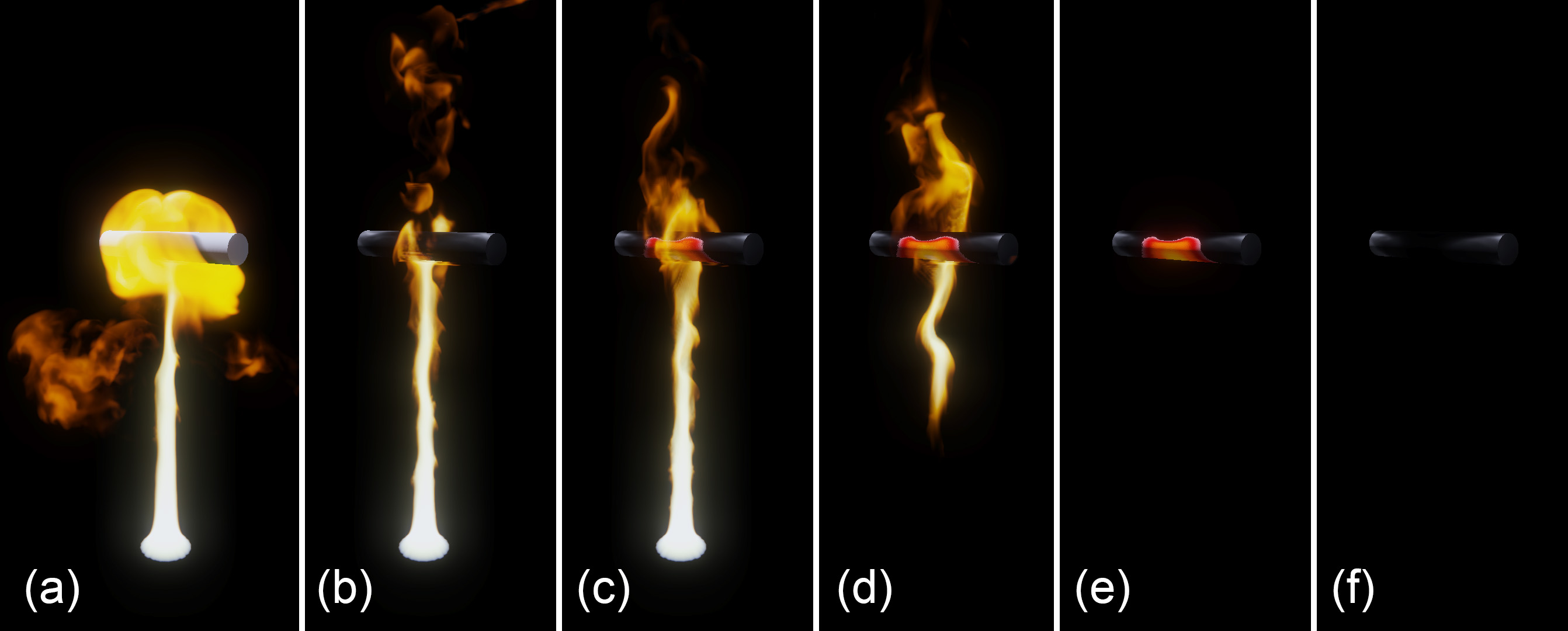
Annealing of a metal rod: a flame is initiated (a) and slowly increases the temperature of a metal rod (b) until it starts to glow (c). After the flame is turned off (d), the rod remains glowing (e) until it is entirely cooled off (f).

Emergency response devices: A stovetop in a kitchen is catching fire (a). After a while a fire detector detects the smoke and starts a water sprinkler (b) to extinguish the fire (c).
BibTeX
@article{wrede2025firex,
  author    = {Wrede, Helge and Wagner, Anton R. and Mahfuz, Sarker Miraz
               and Pa{\l}ubicki, Wojtek and Michels, Dominik L. and Pirk, S{\"o}ren},
  title     = {Fire-{X}: Extinguishing Fire with Stoichiometric Heat Release},
  journal   = {ACM Transactions on Graphics (TOG)},
  year      = {2025},
  month     = {12},
  volume    = {44},
  number    = {6},
  doi       = {10.1145/3763338},
  pages     = {1--17}
}